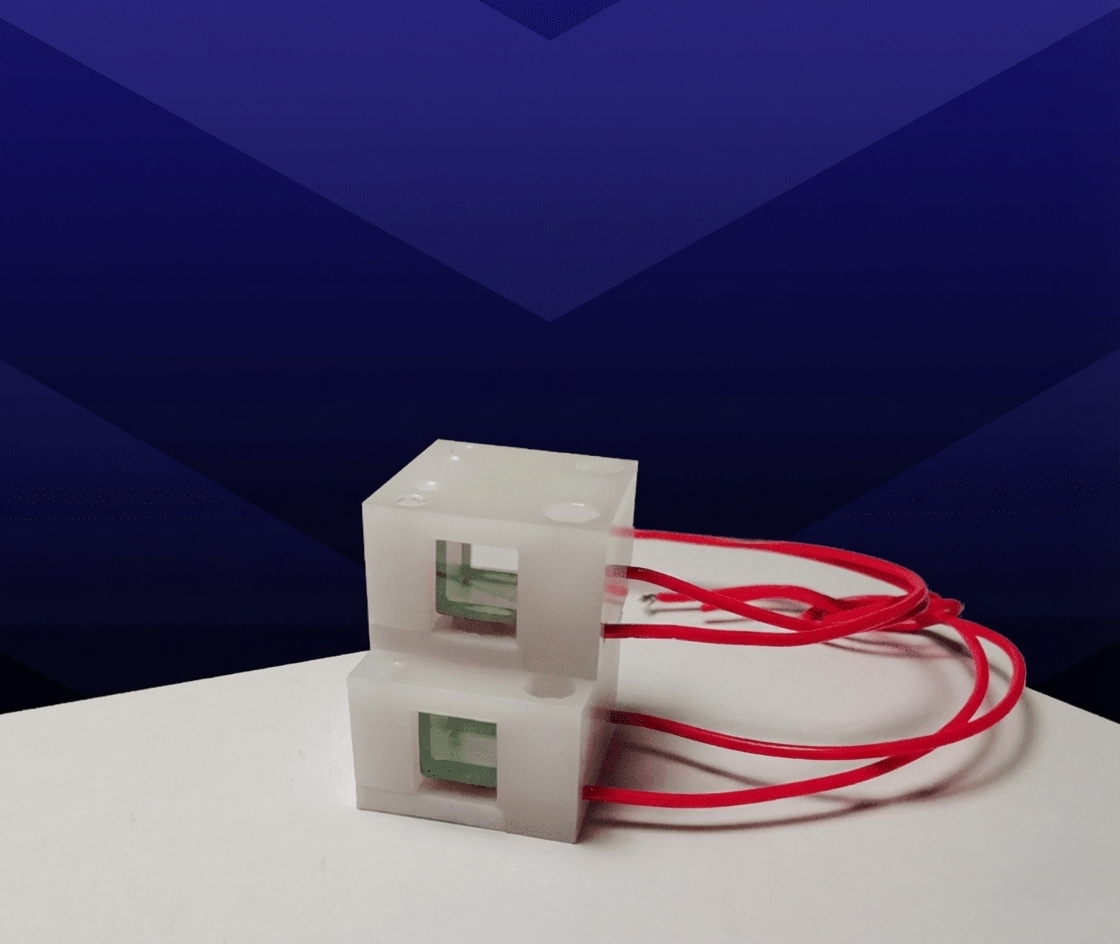
Reflective Wire-Grid Polarizers
Moxtek’s ProFlux® reflective wire-grid polarizers are designed for demanding optical systems that require high transmission, contrast, and wide angular performance. Constructed using advanced nano-imprint lithography on durable glass substrates, these polarizers feature aluminum nanowires that efficiently separate polarization states over a broad range of wavelengths.
Key advantages include:
- High transmission and contrast across the visible spectrum
- Wide acceptance angles, making them ideal for projection and imaging systems
- Rugged and stable construction, capable of withstanding high-intensity illumination and thermal variations
- Compact and versatile design, enabling integration into precision optical assemblies
These polarizers are commonly used in projection displays, heads-up displays (HUD), and scientific instrumentation where reflective configurations are preferred.
Absorptive Wire-Grid Polarizers
Moxtek also offers visible absorptive polarizers that provide excellent polarization uniformity and low reflectivity in compact optical systems. Unlike reflective types, these polarizers absorb the unwanted polarization component, reducing stray light and improving image contrast.
Key characteristics:
- High extinction ratios for precise polarization control
- Excellent optical uniformity across large apertures
- Low surface reflection, minimizing ghosting and back reflections
- Thermal and environmental stability, suitable for laboratory and field use
They are ideal for imaging, microscopy, and display applications where transmitted light quality and system compactness are priorities.
Versatile Polarization Solutions
Together, Moxtek’s reflective and absorptive polarizers cover a wide range of optical design needs - from high-brightness projection and AR/VR optics to precision instrumentation and machine vision. With a commitment to performance consistency and manufacturing excellence, Moxtek provides robust and innovative solutions for visible light polarization in both reflective and transmissive configurations.

.svg)
.svg)









.jpg)




.png)