.svg)
.svg)
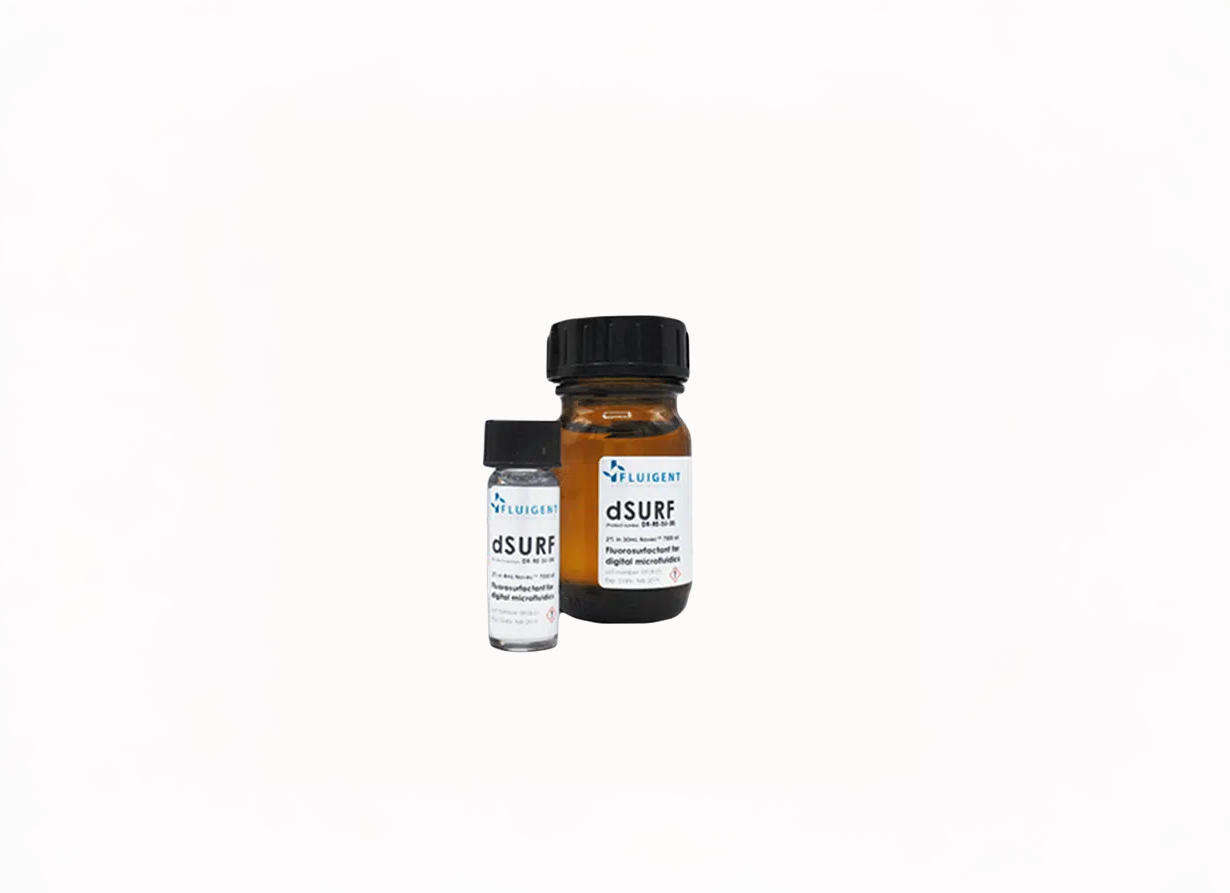

Provided at 2% in dOIL (3M™ Novec™ 7500 fluorinated oil), dSURF allows high-performance droplet formation and long-term stability even in challenging conditions such as dPCR and cell culture experiments.
What is a surfactant?
A surfactant is a molecule composed of a hydrophilic head and a hydrophobic tail, positioned at the interface between the aqueous droplet and the continuous oil solution. It lowers the interfacial tension, enabling longer droplet stability and preventing droplet merging. Using a highly stable fluorosurfactant like dSurf is critical to ensuring good stability for your emulsion.
What are Fluorinated Surfactants used for?
Fluorinated surfactants are often used for droplet generation because they have a number of unique properties that make them ideal for this purpose. These properties include:
- High stability: Fluorinated surfactants can form very stable monolayers at the air-water interface, which can help produce droplets with a narrow size distribution and high stability.
- Low surface tension: Fluorinated surfactants typically have low surface tension, so they can help reduce the interfacial tension between the droplet and the surrounding fluid and make it easier to generate droplets of a specific size.
- Resistance to degradation: Many fluorinated surfactants are resistant to degradation, which means that they can maintain their properties over time, even in harsh environments.
- Chemical inertness: Fluorinated surfactants are often chemically inert, which means that they do not react with other chemicals or substances, making them ideal for use in a wide range of applications.




.jpg)


.png)